
The Best Retinol for Beginners: How to Start Without Wrecking Your Skin
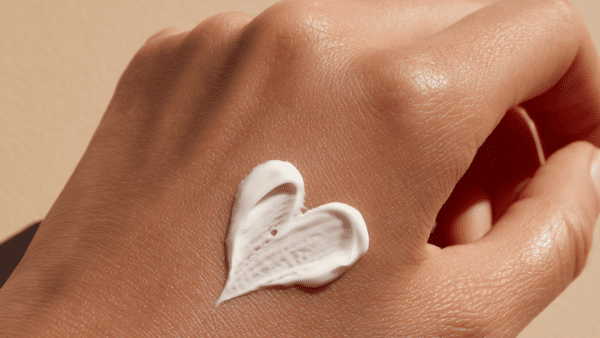
If you’ve been avoiding retinol because you don’t know the best retinol for beginners or you’re scared of the horror stories—red, peeling skin, purging that lasts months—I get it. But retinol is the one anti-aging ingredient that actually works, and if you start smart, you don’t have to suffer through it.
This guide walks you through how to pick a retinol for beginners, what strength to start with based on your skin type, how to use it without destroying your face, and what to expect in the first few months. No gatekeeping, no fear-mongering, just what actually works.
Why Retinol Is the One Product Dermatologists Actually Agree On
Retinol is a form of vitamin A that speeds up cell turnover, which means it helps your skin shed dead cells faster and produce new ones. That’s why it works for both anti-aging (smoothing fine lines, evening texture) and acne (preventing clogged pores).
Here’s what retinol actually does:
- Reduces fine lines and wrinkles – Clinical studies show visible improvement in 12 weeks
- Evens skin tone – Fades dark spots and hyperpigmentation
- Improves texture – Smooths rough, bumpy skin
- Prevents breakouts – Keeps pores clear by increasing cell turnover
- Boosts collagen production – This is the long-term benefit that keeps your skin looking younger
The reason dermatologists push it so hard is because it’s one of the few over-the-counter ingredients with decades of research backing it up. It works. The catch is that it can irritate your skin if you use it wrong, which is why most people either quit or never start.
How to Pick a Retinol Strength Based on Your Skin Type
If you’ve never used retinol before, don’t start with the strongest percentage you can find. That’s how you end up with a peeling, red face and a $60 bottle sitting in your drawer because you’re too scared to use it. The following is a guide for how to find the best retinol for beginners.
Over-the-counter retinol typically ranges from 0.25% to 1%. Here’s how to figure out where you should start:
If You Have Sensitive Skin or Rosacea
Start with: 0.25% – 0.3%
Sensitive skin gets irritated easily, and retinol is inherently irritating. Starting low gives your skin time to adjust without triggering redness or inflammation.
Good options:
- CeraVe Resurfacing Retinol Serum (0.3%) – Drugstore, gentle, includes ceramides to protect your barrier
- La Roche-Posay Redermic R Anti-Aging Retinol Treatment (0.3%) – Designed for sensitive skin, includes soothing ingredients
- Bakuchiol serums (like Herbivore Bakuchiol Serum) – Not technically retinol, but a gentler alternative if your skin can’t tolerate retinol at all
If You Have Normal Skin and Have Never Used Retinol
Start with: 0.5%
This is the sweet spot for most people. It’s strong enough to see results within a few months but gentle enough that you probably won’t hate your life.
Good options:
- The Ordinary Retinol 0.5% – Affordable, straightforward, squalane base makes it less drying
- Neutrogena Rapid Wrinkle Repair Retinol Serum – Drugstore, widely available, good texture
- RoC Retinol Correxion Deep Wrinkle Serum – Classic retinol product with a solid track record
If Your Skin Is Oily or You’ve Used Retinol Before
Start with: 0.5% – 1%
Oily skin tends to tolerate retinol better because it’s not as prone to dryness, but don’t assume you’re invincible. Even oily skin can get irritated.
Good options:
- The Ordinary Retinol 1% – Highest strength from The Ordinary
- SkinCeuticals Retinol 1.0 – Expensive but well-formulated, includes bisabolol to calm irritation
- Differin Gel (0.1% adapalene) – Technically a retinoid, not retinol, but available over-the-counter and very effective for acne and texture
One More Thing: Percentage Isn’t Everything
A 1% retinol from one brand might be way more irritating than another because formulation matters. Products with a lot of alcohol, fragrance, or essential oils will be harsher even at lower percentages. Look for formulas that include soothing ingredients like niacinamide, ceramides, or squalane.
If You Want to Spend More: Luxury Retinol Options
You don’t need to spend $150 on retinol to see results. The Ordinary’s $10 retinol works. But if you have the budget and want a more elegant texture, better packaging, or additional anti-aging ingredients in the same product, here are the luxury options actually worth considering.
SkinCeuticals Retinol 0.5
What you’re getting: Medical-grade formulation with bisabolol (a soothing ingredient) to reduce irritation. The texture is smoother than drugstore retinols, and it includes antioxidants to boost the anti-aging benefits.
Worth it if: You have the budget and want a formula that feels luxurious. The texture makes it easier to layer under other products, and the soothing ingredients mean less irritation.
Drunk Elephant A-Passioni Retinol Cream (1% retinol)
What you’re getting: A higher percentage (1%) in a creamy base with peptides and vitamin F. It’s strong but formulated to minimize irritation. The texture is thick and moisturizing, so you might not need a separate moisturizer afterward.
Worth it if: You have normal to dry skin and want an all-in-one product. The peptides add extra anti-aging benefits beyond just retinol.
Shani Darden Retinol Reform
What you’re getting: A cult favorite that comes in graduated strengths so you can work your way up. It includes lactic acid (a gentle exfoliant) and niacinamide (calming and brightening).
Worth it if: You want a product with a strong track record and you like the idea of moving through different strengths from the same brand as your skin builds tolerance.
Augustinus Bader The Retinol Serum
What you’re getting: The most expensive option on this list. It combines retinol with Augustinus Bader’s proprietary TFC8 complex (amino acids, vitamins, and peptides). The idea is that you’re getting retinol plus a bunch of other anti-aging ingredients in one serum.
Worth it if: Honestly, probably not unless you’re already deep into luxury skincare and money isn’t a concern. The Ordinary’s retinol will give you similar results for a fraction of the price. This is for people who want the full luxury experience and don’t mind paying for it.
What You’re Actually Paying For
Luxury retinol products typically offer:
- Better texture – Silkier, easier to spread, more elegant under makeup
- Additional active ingredients – Peptides, antioxidants, ceramides all in one product
- Less irritation – More soothing ingredients built into the formula
- Prettier packaging – Let’s be honest, it matters to some people
What you’re NOT paying for:
- Better retinol – The retinol molecule is the same whether it costs $10 or $190
- Faster results – A $150 retinol won’t work faster than The Ordinary’s version
My Take
I started with The Ordinary and it worked great. When I moved to prescription tretinoin, I didn’t need the luxury retinols anymore. But if I were buying over-the-counter retinol now and had the budget, I’d probably go with SkinCeuticals or Drunk Elephant because the textures are nicer and I like having other anti-aging ingredients in the same product.
Start with something affordable. If you love retinol and want to upgrade later, then consider the luxury options. But don’t feel like you’re missing out if you stick with drugstore—you’re not.
The Retinol Sandwich Method: How to Buffer Without Losing Results
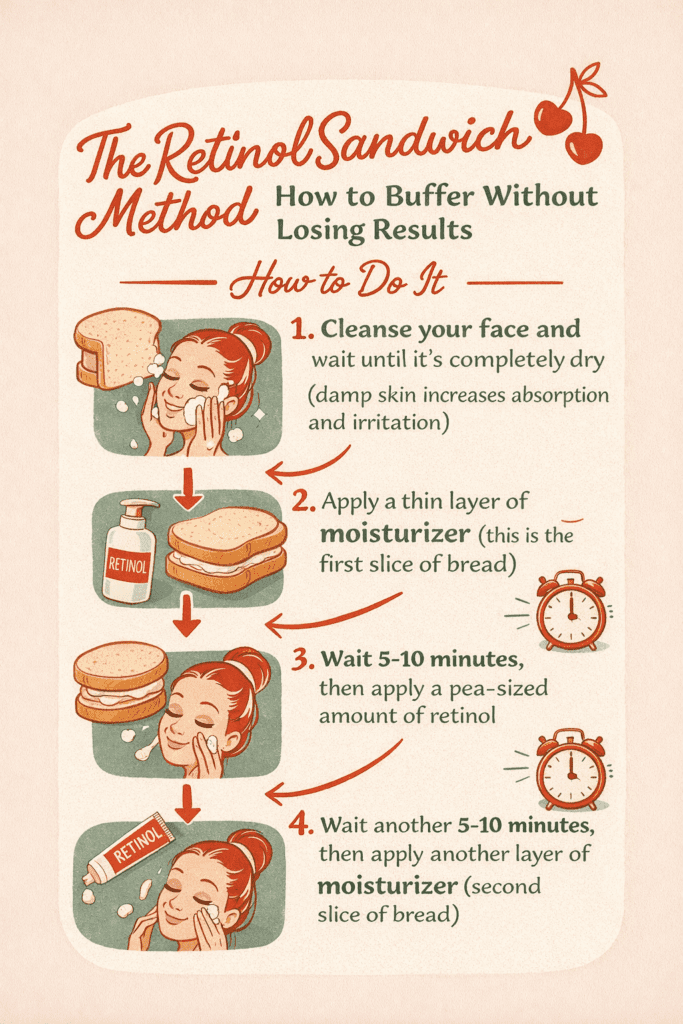
The “retinol sandwich” is the easiest way to start retinol without wrecking your skin. It’s exactly what it sounds like: you sandwich your retinol between layers of moisturizer to buffer the irritation.
How to Do It
Step 1: Cleanse your face and wait until it’s completely dry (damp skin increases absorption and irritation)
Step 2: Apply a thin layer of moisturizer (this is the first slice of bread)
Step 3: Wait 5-10 minutes, then apply a pea-sized amount of retinol
Step 4: Wait another 5-10 minutes, then apply another layer of moisturizer (second slice of bread)
Does Buffering Make Retinol Less Effective?
No. Studies show that buffering reduces irritation without significantly reducing results. You might see results slightly slower, but if irritation makes you quit, you get zero results. Slow and steady wins.
When to Stop Buffering
After 4-6 weeks, if your skin is handling it well with no redness, peeling, or sensitivity, you can try skipping the first layer of moisturizer. Eventually, you might be able to use retinol on bare skin, but there’s no rush.
Good Moisturizers for Buffering
You want something simple, fragrance-free, and barrier-repairing:
- CeraVe Moisturizing Cream – Thick, ceramide-rich, drugstore
- La Roche-Posay Cicaplast Baume B5 – Very soothing, good for irritated skin
- Vanicream Moisturizing Cream – Minimal ingredients, dermatologist favorite
My 3-Month Before and After (and What I Wish I’d Known)
I started retinol three years ago because I was tired of watching my skin texture get worse. I was 32, and I could see fine lines starting, plus my skin tone was uneven from overall thin skin.

What I Used
I started with The Ordinary Retinol 0.5% in Squalane. I picked it because it was affordable, well-reviewed, and I figured if it didn’t work out, I wasn’t out much money.
My Routine
Weeks 1-2: Retinol sandwich method, 2x per week (Monday and Thursday)
Weeks 3-4: Retinol sandwich, 3x per week
Weeks 5-8: Dropped the first layer of moisturizer, still 3x per week
Weeks 9-12: Retinol on bare skin, worked up to every other night
What Happened
Week 1: Nothing. My skin looked the same.
Week 2: Slight dryness around my nose and chin, but no redness or peeling.
Week 4: Texture started looking smoother. The little bumps on my forehead were less noticeable.
Week 8: My skin tone looked more even. Old acne scars were fading.
Week 12: Fine lines around my eyes were softer. My skin overall just looked better—brighter, smoother, more even.
What I Wish I’d Known
- It’s boring at first – Nothing dramatic happens in week one. You just have to keep going.
- Sunscreen is non-negotiable – Retinol makes your skin more sensitive to sun damage. If you’re not using SPF 30+ every morning, don’t bother with retinol.
- Purging is real but short – Around week 3, I had a few breakouts. This is normal—retinol speeds up cell turnover, so clogged pores come to the surface faster. It cleared up by week 5.
- You don’t need to use it every night – I settled at 3-4 nights per week and saw great results. More isn’t always better.
- Patience pays off – The real improvements came between months 2 and 3. If you quit at week 4, you miss the good part.
Why I Eventually Switched to Tretinoin
After about a year on over-the-counter retinol, my skin had adjusted and I wanted stronger results. I asked my dermatologist about prescription tretinoin (which is stronger than OTC retinol) and started on 0.025%.
The adjustment period was rough—even though I’d been using retinol for a year, tretinoin is significantly more potent. I had to go back to the sandwich method for the first month. But the results were noticeably better: faster cell turnover, smoother texture, and my hyperpigmentation faded faster.
Should you start with tretinoin instead of retinol? No. Unless you have severe acne or significant sun damage, there’s no reason to jump straight to prescription. Over-the-counter retinol works for most people, it’s cheaper, and you can buy it without a doctor’s appointment. Start there, give it 6-12 months, and if you want more, then talk to a dermatologist about prescription options.
Final Thoughts: Just Start
Retinol works, but only if you actually use it. Start with a low percentage, buffer with moisturizer, and give it 12 weeks before you decide if it’s working.
Don’t overthink it. Pick one of the products I listed, follow the sandwich method, and see what happens. You can always adjust later.
Quick recap:
- Sensitive skin: Start with 0.25%-0.3%
- Normal skin: Start with 0.5%
- Oily skin or experienced users: Start with 0.5%-1%
- Use the sandwich method for the first month
- Wear sunscreen every morning
- Give it 12 weeks before judging results
If your skin gets too irritated, scale back. If it’s fine, keep going. That’s it.
Frequently Asked Questions About Retinol for Beginners
Can I use retinol every night?
Not when you’re starting out. Begin with 2-3 nights per week for the first month, then gradually increase to every other night if your skin tolerates it well. Some people eventually use it every night, but many see great results using it just 3-4 times per week. More isn’t always better—overusing retinol leads to irritation without better results.
How long does retinol purging last?
Purging typically lasts 2-6 weeks. You’ll see small breakouts as retinol speeds up cell turnover and brings clogged pores to the surface faster. If you’re still breaking out after 6 weeks, it might not be purging—it could be irritation or a reaction to the product. If your skin is red, burning, or getting worse after 6 weeks, stop using it.
Can I use retinol with vitamin C or niacinamide?
Yes, but not at the same time. Use vitamin C in the morning and retinol at night. Niacinamide can be layered with retinol—it actually helps reduce irritation. Just apply niacinamide first, wait a few minutes, then apply retinol.
Should I use retinol around my eyes?
You can, but be careful. The skin around your eyes is thinner and more sensitive. If you want to use retinol for crow’s feet or under-eye texture, start by applying it only to your orbital bone (not directly on your eyelid or too close to your lash line). Some brands make specific eye retinol products that are formulated to be gentler.
Is retinol safe during pregnancy?
No. Retinol and all retinoids (including prescription versions like tretinoin) should be avoided during pregnancy and breastfeeding. High doses of vitamin A have been linked to birth defects. If you’re pregnant or planning to become pregnant, stop using retinol and talk to your doctor about safe alternatives like azelaic acid or vitamin C.
What’s the difference between retinol and retinoid?
Retinoid is the umbrella term for all vitamin A derivatives. Retinol is a specific type of retinoid available over-the-counter. Prescription retinoids (like tretinoin, adapalene, tazarotene) are stronger and work faster but also cause more irritation. If you’re new to retinoids, start with over-the-counter retinol.
When will I see results from retinol?
You’ll start seeing smoother texture around 4-6 weeks. For fine lines, dark spots, and significant anti-aging results, expect 8-12 weeks. Retinol is a long game—if you quit before 3 months, you won’t see the real benefits.
Can I use retinol if I have acne?
Yes. Retinol helps prevent breakouts by keeping pores clear and speeding up cell turnover. If you have active acne, you might experience purging for the first few weeks as clogged pores surface faster. Stick with it—most people see clearer skin after the purging phase ends.
When should I consider switching to prescription tretinoin?
After 6-12 months of consistent over-the-counter retinol use, if you want stronger results or your skin has fully adjusted and you’re not seeing further improvement. Tretinoin is more potent—it works faster and delivers more dramatic results, but it also causes more irritation. You’ll need a prescription from a dermatologist. Don’t skip the retinol step and go straight to tretinoin unless your dermatologist recommends it for specific skin concerns like severe acne or advanced sun damage




One Comment
Comments are closed.