Vermilion Flycatcher: A Spark of Fire on the Fence Line
Some birds you attract. The Vermilion Flycatcher is one you earn — by building a yard so full of insects and good perches that a flame decides to stay.
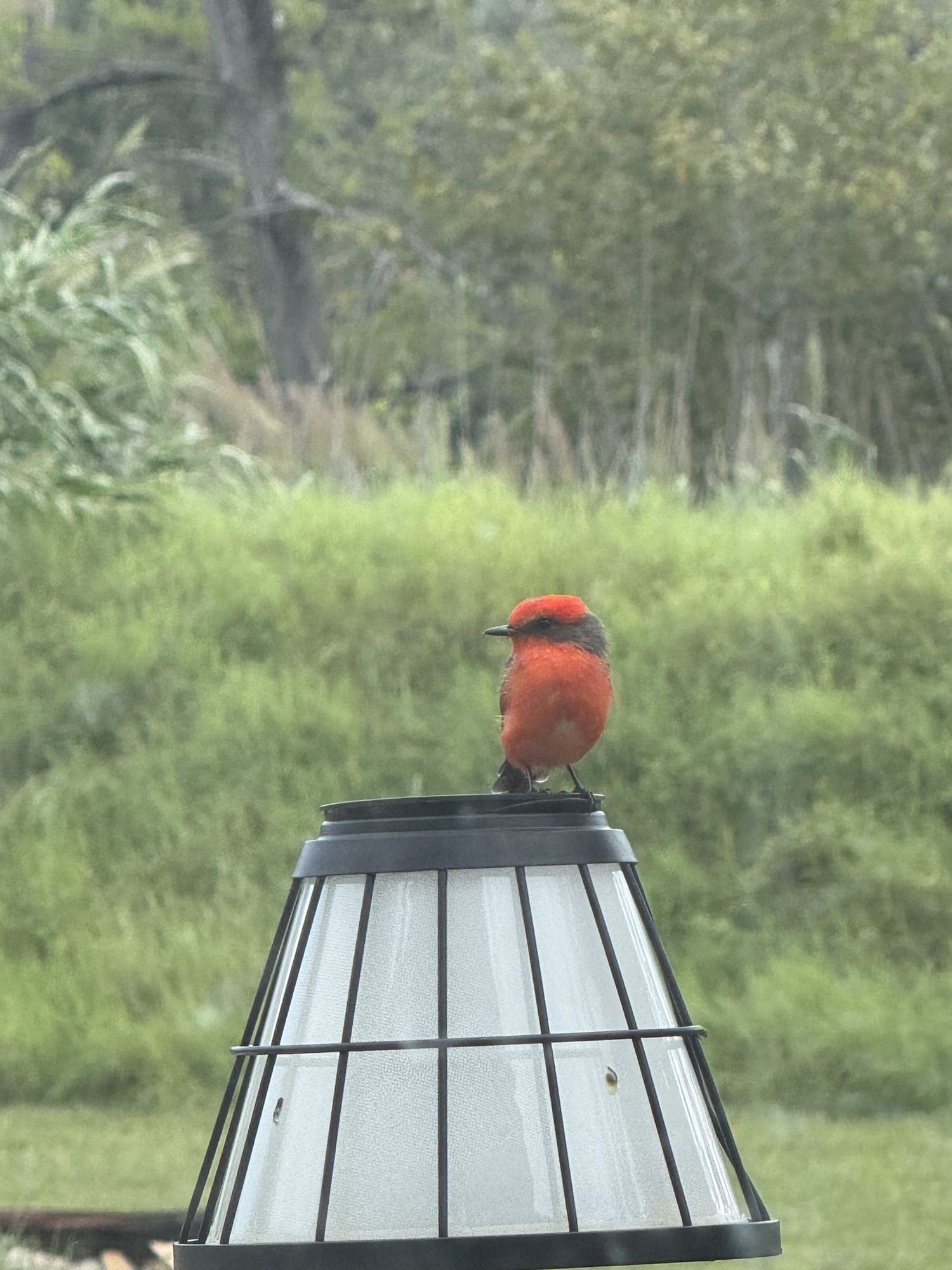
There is no mistaking a male Vermilion Flycatcher. He is a small bird wearing an outrageous amount of red: a glowing scarlet crown and underside set against a smart brown mask and back. He perches out in the open, low to the ground, then sallies out to snap an insect from the air and returns to the exact same twig.
We sit near the eastern edge of his Texas range here in the Hill Country, which makes every sighting feel like a small event. Females and young birds trade the fire for a peachy, salmon-washed belly — subtle and gorgeous in their own right.
The quick facts
When you’ll see it in the Hill Country
In Central Texas, Vermilion Flycatchers are most reliable from spring into fall. They’re local and patchy — some birds linger into winter farther south, but around here the warm months are your best bet.
Where the Vermilion Flycatcher comes from
The Vermilion Flycatcher is a bird of the American Southwest and the warm Americas — its range sweeps from the southwestern U.S. down through Mexico and Central America all the way into South America. Texas is one of the best places in the country to find one.
Birds in the core of the range are largely resident, but the northern edge — that’s us — sees a seasonal pulse, with many individuals pulling south for winter and returning to hunt and breed in the warmer months.
What it eats
This is a pure insectivore. It does not eat seed, and it will never visit a seed feeder — so if you’re hoping for one, the strategy is completely different from your finches and buntings.
Its menu is flying insects: bees, wasps, flies, grasshoppers and beetles, caught on quick aerial sorties from a low, open perch.
How to bring it to your yard
You don’t feed a Vermilion Flycatcher — you build it a hunting ground.
🪶 Feeder field guide
Skip the feeders entirely. What this bird wants is insects, which means the real “food” you offer is a pesticide-free yard with healthy native plants that keep bugs around.
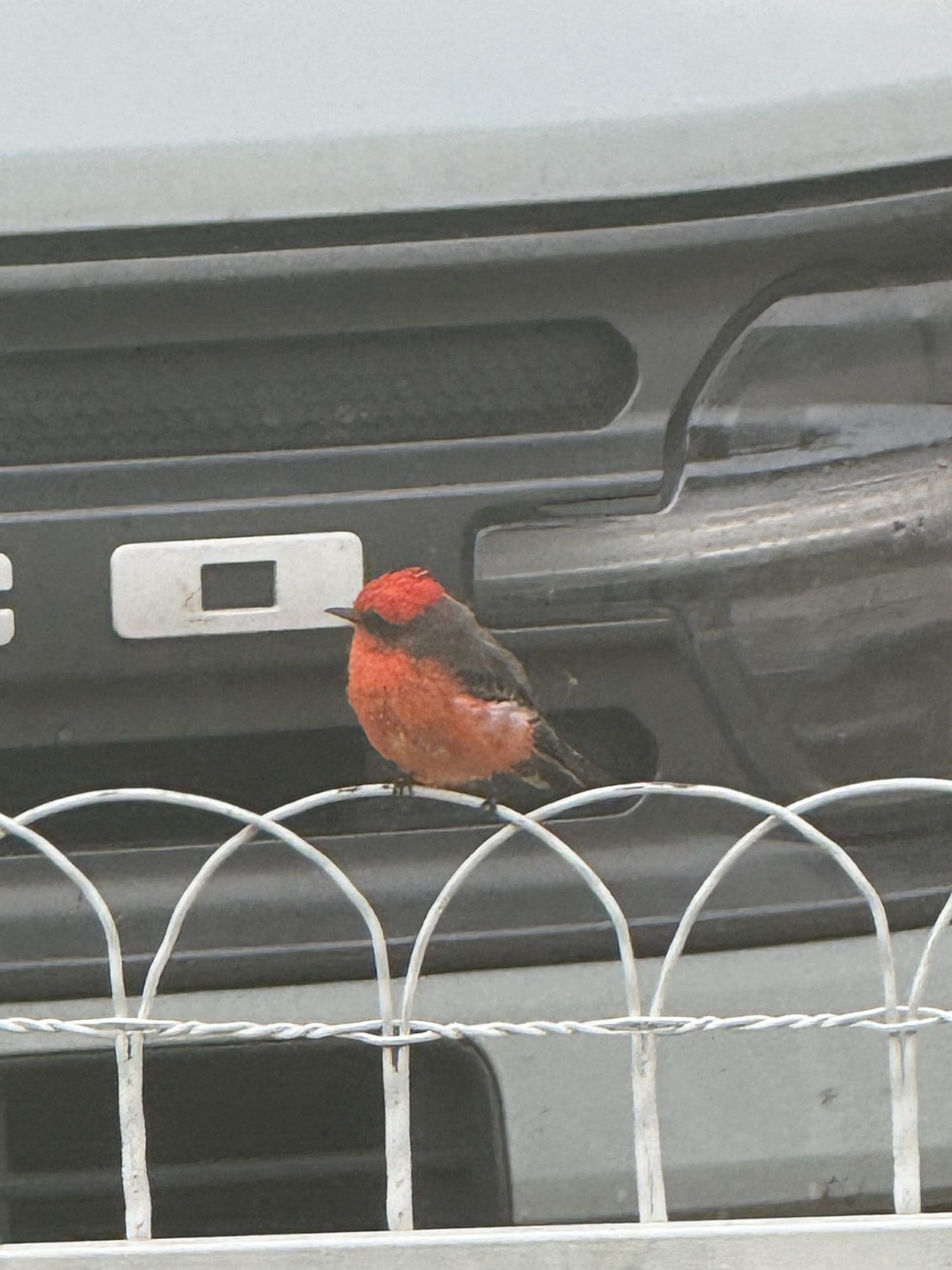
Give it low, open perches — a fence wire, a short stake, a garden lamp, a bare branch over open ground. It hunts from these lookouts. A water feature and a sunny, semi-open lawn edge make your yard far more appealing.
Go easy on the insecticides. The single biggest thing you can do for flycatchers is to let your yard be a little wild and a little buggy. No insects, no flame on the fence.
Hear it & map it
Listen for a soft, tinkling pit-a-see, pit-a-see, often given by the male during a fluttering display flight as he climbs and parachutes back down.
Telling them apart
The adult male is pure theater: a scarlet crown and underside set against a dark chocolate-brown mask, back, wings, and tail. There’s no mistaking him.
Females and young birds are far subtler — gray-brown above, a whitish breast with fine streaking, and a lovely peachy-salmon wash low on the belly. Young males moulting into adult plumage look delightfully patchy, with red coming in across a still-brownish body.
Nesting & raising young
The female builds a small, flat cup nest out on a horizontal branch, often decorated with lichen and bound with spiderweb, and typically not far from water. She lays two to three eggs while the male stands guard nearby.
His courtship is the best show in the yard: he climbs high into the air, puffs out his red feathers, flutters in place while singing, then parachutes slowly back down. Males will sometimes present a showy insect — even a butterfly — to the female as a gift.
💡 Did you know?
- The genus name Pyrocephalus means “fire head” — about as accurate as a name gets.
- In some parts of their range, a few males are unusually dark or even sooty-black instead of red.
- They hunt almost entirely by sight, which is why open perches matter so much to them.
Common questions
Will a Vermilion Flycatcher ever come to a feeder?
No — they eat only insects and won’t touch seed or suet. You attract them with water, open perches, and a pesticide-free yard, not a feeder.
Are they rare in the Texas Hill Country?
They’re local and a bit hit-or-miss here, since we sit near the eastern edge of their Texas range — which is exactly what makes spotting one feel special.
Where’s the best place to find one?
Open ground near water: pond edges, ranch fence lines, parks, and golf courses, where they perch low and dart out after flying insects.
Watching one hunt the fence line is the kind of quiet thrill that pulls you out of your own head. It all started when I turned one window into a tiny bird sanctuary during my work-from-home days — here’s how I built it (and why it steadied me).