House Sparrow: The City Bird That Followed Us Everywhere
No bird is more tangled up with human life than the House Sparrow. Love it or wrestle with it, it’s a mirror of us.
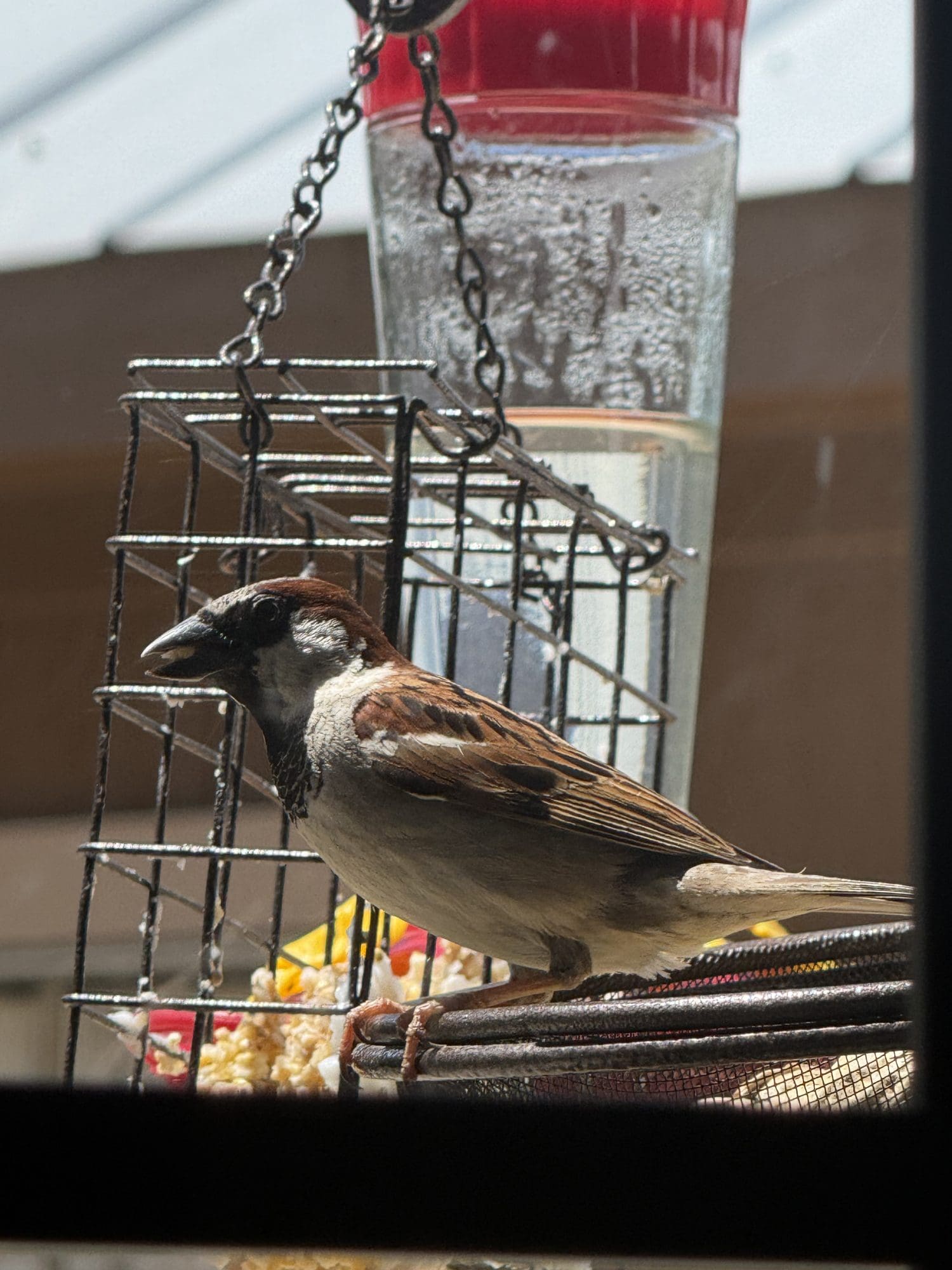
The House Sparrow is the bird of parking lots, porch eaves, and outdoor café tables — chunky, chattering, and utterly comfortable around people. Breeding males wear a sharp gray cap, black bib, and chestnut shoulders; females and young are a soft streaky brown.
Here’s the honest part: the House Sparrow is not native to North America. It’s an Old World bird from Europe, Asia, and North Africa, and the reason it’s here at all is us.
The quick facts
When you’ll see it in the Hill Country
House Sparrows are non-migratory and present every single month. They don’t leave, they don’t really wander — they just settle in wherever people are.
Where the House Sparrow comes from
Native across Europe, Asia, and North Africa, House Sparrows were deliberately introduced to Brooklyn, New York in the early 1850s and again at several other sites. From those few releases they spread across the entire continent in a matter of decades — one of the most successful bird introductions in history.
They’re a textbook “commensal” species: they thrive specifically alongside human settlement, from farms to downtowns, and rarely stray far from buildings and people.
What it eats
House Sparrows are opportunistic generalists. The bulk of their diet is seeds and grain — plus a healthy appetite for human crumbs, from spilled fries to bread at a picnic table. In the breeding season they add insects to feed their chicks.
At feeders they’ll eat almost anything, but they especially pile onto millet, cracked corn, and cheap mixed seed.
How to bring it to your yard
Most people don’t need to attract House Sparrows — they need to manage them. Here’s how to do both fairly.
🪶 Feeder field guide
If you want to watch them, offer millet or cracked corn on a platform feeder. If you’d rather steer them elsewhere, skip mixed seed and cheap blends — the millet and corn in those mixes are exactly what draw big sparrow crowds.
They’re happiest at open platform or hopper feeders near buildings and shrubs. Tube feeders with short perches and no tray make life a little harder for them and a little easier for finches and buntings.
Be mindful around nest boxes. As cavity nesters, House Sparrows compete aggressively with native birds like bluebirds and can take over boxes. If you’re hosting bluebirds, keep an eye on the box and don’t let sparrows claim it.
Hear it & map it
Not a songbird in the classic sense — just an endless, sociable series of cheep cheep chirrup notes from a hedge or gutter. It’s the soundtrack of human places the world over.
Telling them apart
A breeding male is sharp: a gray crown, black bib and mask, chestnut nape, and a clean white cheek. In winter the black bib fades and gets veiled in pale feather tips, so he looks duller.
Females and young birds are a plain, buffy-brown all over, with a streaked back, a stout pale bill, and a soft pale line behind the eye — no bib, no bold markings. That very plainness, plus a chunky build and a big bill, is how you separate them from our streakier, finer-billed native sparrows.
Nesting & raising young
House Sparrows nest in cavities and crevices — building eaves, signs, traffic lights, dryer vents, and nest boxes — and cram them with a messy wad of grass and trash. A pair may raise up to four broods a year, which is a big reason they’re so abundant.
They’re also famously aggressive nesters: they’ll evict native birds like bluebirds and swallows from boxes and may destroy eggs to claim a cavity. Because they’re non-native, they aren’t protected under the U.S. Migratory Bird Treaty Act — though any control should always be humane and lawful.
💡 Did you know?
- They’re among the most widely distributed wild birds on the planet, found on six continents — almost always alongside people.
- House Sparrows have lived in close company with humans for roughly 10,000 years, since the dawn of agriculture.
- Despite the name and the look, they’re not closely related to North America’s native sparrows at all.
Common questions
Is the House Sparrow native to North America?
No. It’s an Old World bird, deliberately introduced to New York in the 1850s, that spread across the continent in a few decades.
How do I keep House Sparrows off my feeders?
Skip millet, cracked corn, and cheap mixed seed — those draw the biggest crowds. Tube feeders, safflower, and nyjer are far less appealing to them.
Are they protected?
As a non-native species they aren’t covered by the Migratory Bird Treaty Act, but you should still always act humanely and within local law.
How do I tell a House Sparrow from a native sparrow?
House Sparrows are stockier and bigger-billed, plainer-faced, and almost always tied to buildings and people rather than open countryside.
Even the common birds have a way of keeping you company through a long workday. It all started when I turned one window into a tiny bird sanctuary during my work-from-home days — here’s how I built it (and why it steadied me).