What Is an Analog Cart — and Why Is Everyone Building One?

If you’ve been anywhere near TikTok or Instagram lately, you’ve probably seen people filling wicker carts with journals, washi tape, and markers and calling it their “analog cart.” And if your first reaction was that’s exactly what I need — same. I built one, and I want to walk you through everything that went into mine and why this trend is honestly one of the more grounding things I’ve done this year.
But first: what actually is an analog cart, and why is it having a moment right now?
The Analog Trend: What’s Going On
2026 has been widely dubbed “the year of the analog” — and there’s real data behind it, not just a vibe. The analog trend is defined as a movement toward embracing physical and tactile experiences over digital ones, driven by a cultural response to digital burnout, AI fatigue, and the loss of intentionality.
Michaels, which tracks craft and creative trends across its nearly 1,400 stores, officially declared 2026 the Year of Creative Living. Their data found that searches for analog hobbies like knitting, crocheting, embroidery, journaling, and painting surged 136% over the past six months, and junk journaling searches are up 63% year-over-year. That’s not a niche corner of the internet anymore — that’s a full-scale cultural shift.
People are increasingly seeking ways to reclaim their attention from constant digital distractions. Social media use has plateaued or declined in many countries, and younger generations are turning to screen-free activities like journaling, reading books, and board games.
An analog cart is one really practical way to lean into this. It’s a dedicated rolling cart — usually something you can park next to the couch or your reading chair — stocked with every offline creative supply you might want to reach for. The whole point is removing friction: when your supplies are organized, visible, and within arm’s reach, you actually use them instead of defaulting to your phone.
My Analog Cart: A Full Breakdown
Here’s exactly what went into mine, tier by tier.
The Cart
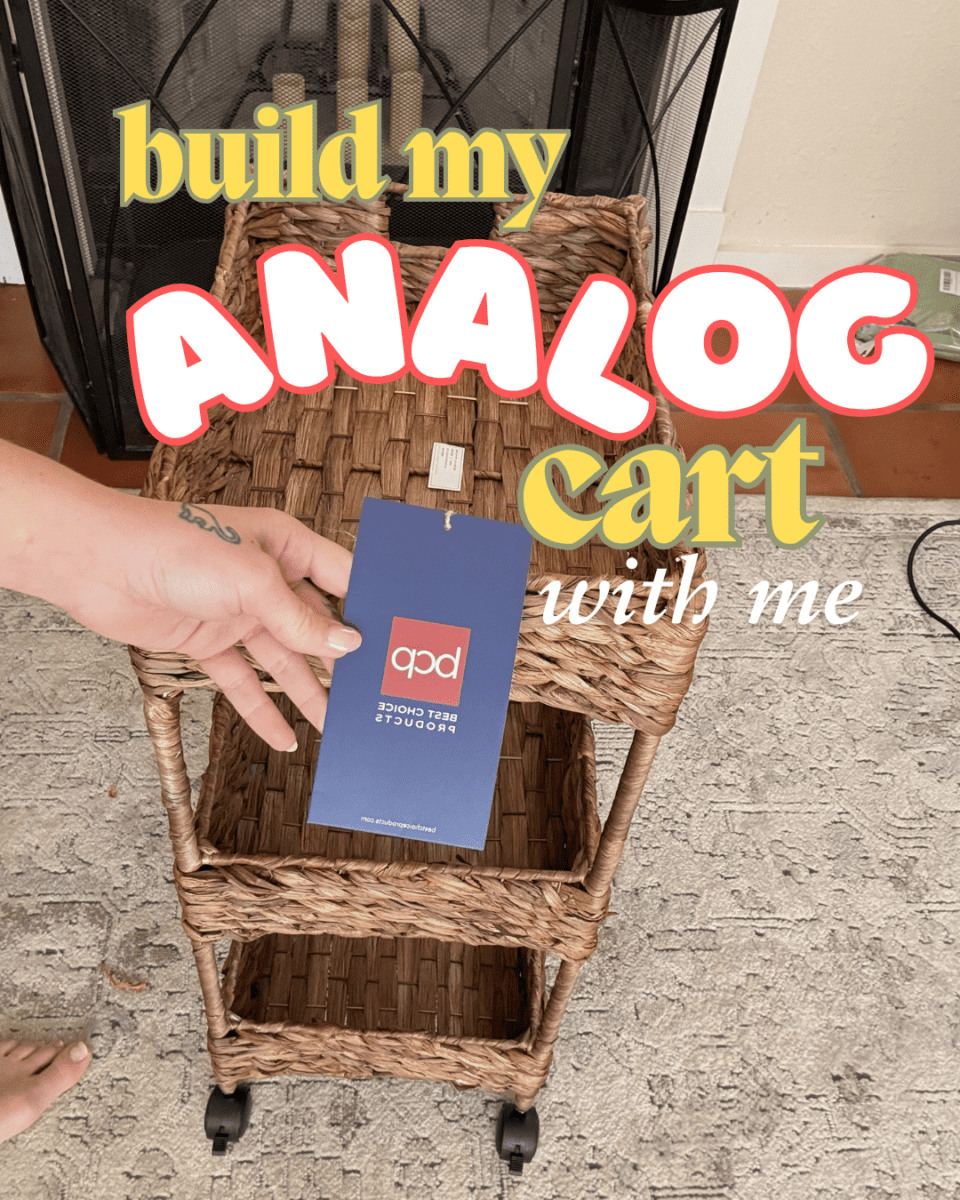
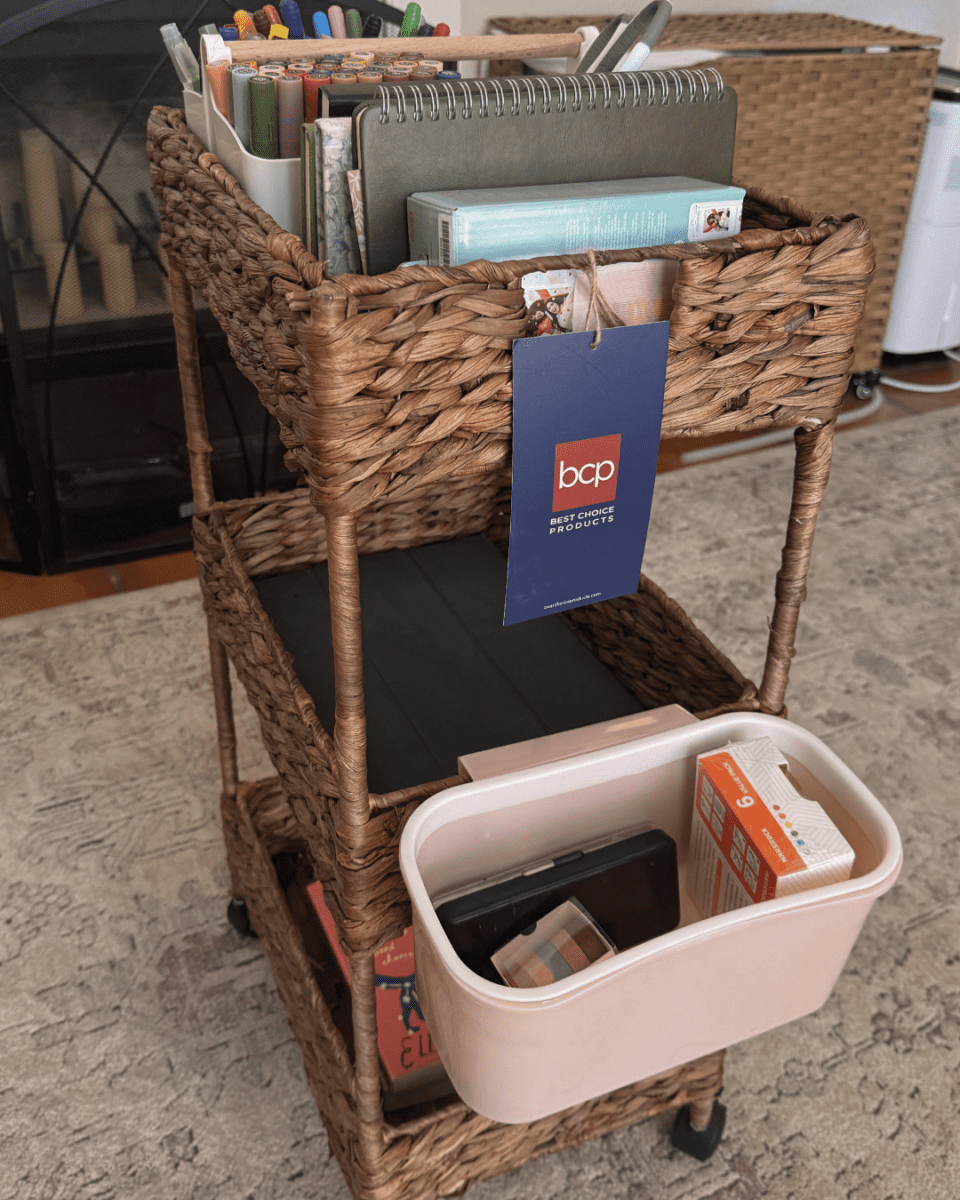
I used a three-tier wicker rolling cart from Best Choice Products. It has two deep basket shelves and an open bottom tray, rolls on little casters, and looks genuinely pretty sitting next to the fireplace. That last part matters to me — if something is ugly, I won’t use it. The natural wicker fits my aesthetic perfectly and doesn’t look like office storage.
Top Tier: Journals and Writing Tools
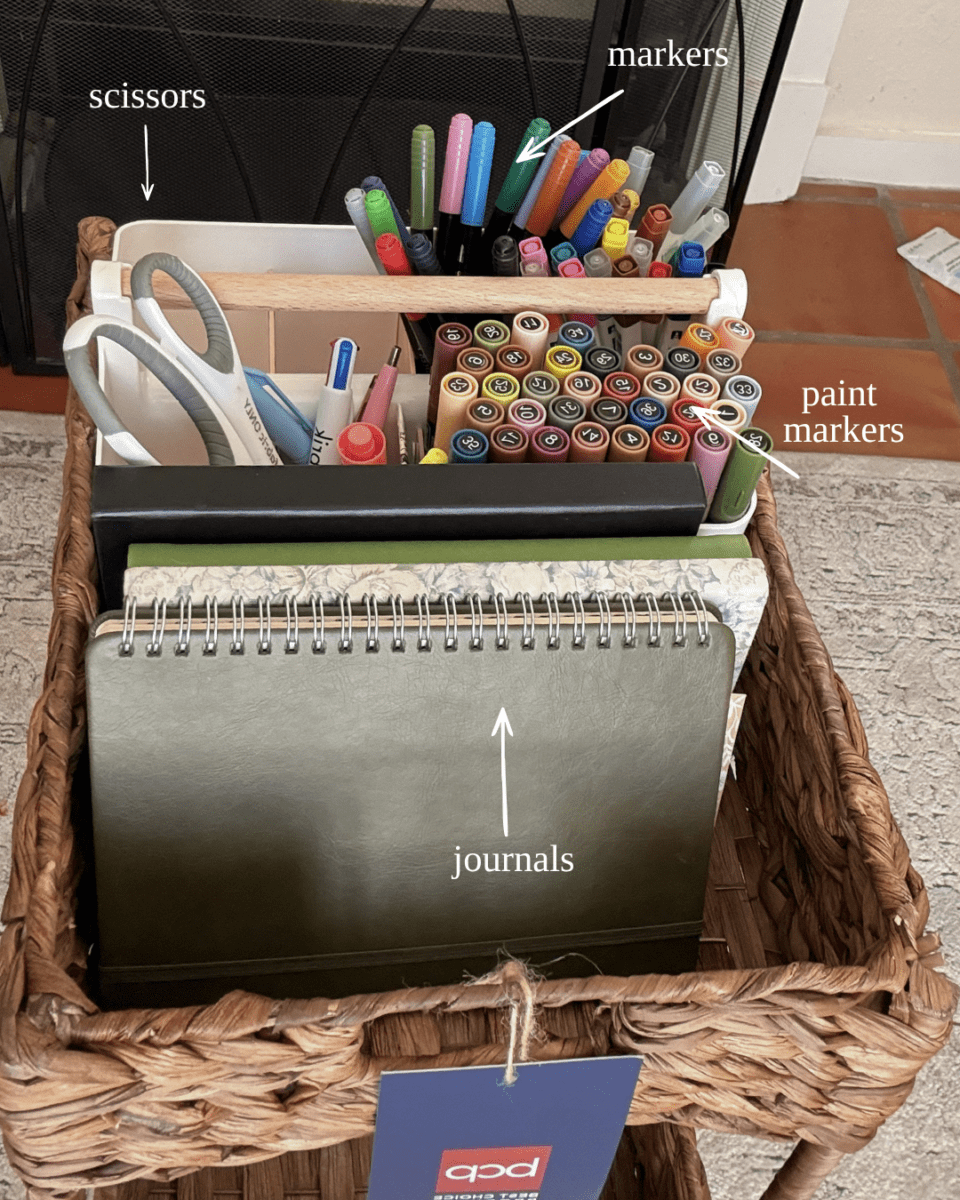
The top basket holds everything I use for daily writing and drawing. I keep my supplies in a couple of small organizers so nothing piles up into chaos.
For writing tools, I have a full set of numbered alcohol markers sorted by color family, a set of paint markers (current obsession — they look incredible on darker paper), scissors, and a handful of everyday pens. Having everything visible is half the battle. When you can see your supplies, you actually reach for them.
Alongside the supplies, I keep a small stack of journals rotating at any given time — right now it’s a dark olive leather-look spiral for daily reflection, a floral-covered notebook for ideas and lists, and a black hardcover for longer brain dumps. Multiple journals with different purposes keeps each one intentional rather than a chaotic everything-dump.
Middle Tier: Current Projects + The Cutting Mat
The middle shelf is my “active project” zone. Right now it’s holding a scrapbooking kit I’m working through, plus the books I’m currently reading: The Mountaintop School for Dogs and Other Second Chances by Ellen Cooney, and a second book I’m still making my way through.
I also use this shelf to store my green self-healing cutting mat when I’m not actively using it. It slides in vertically and stays out of the way, which means when I do want it, it’s right there — no hunting through drawers.
Bottom Tier: The Small Supplies Bin
The bottom tier holds a blush pink plastic bin for all the smaller, looser supplies — and honestly the color contrast against the wicker is really cute. Inside:
- Precision craft knife kit — a full set of blades in a clear plastic case. Non-negotiable for clean cuts in paper crafting or collage.
- Marsrock Dots Adhesive Roller set — six colors, 48 total rollers. If you’re still using liquid glue for journaling or collage, adhesive dots are a game changer. Clean, fast, zero warping on paper.
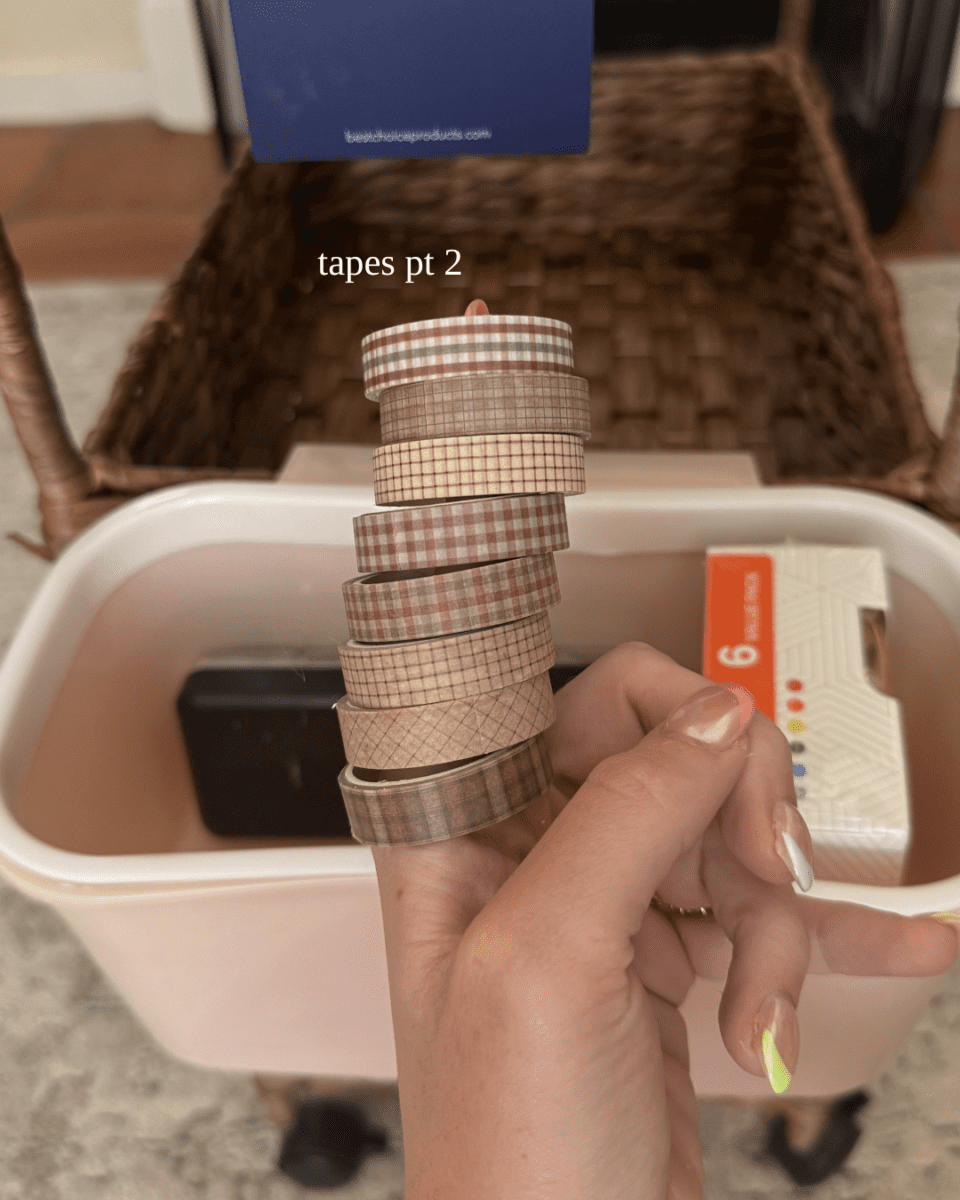
- Washi tape — two sets: a boxed set of solid tonal tapes in dusty rose, slate blue, burgundy, and tan, plus a stack of patterned washi in gingham, plaid, and grid prints. All muted, earthy tones. Very cottagecore ranch house, which is very much my brand.
- Sticky notes — always room for a value pack at the bottom of the bin.
Why This Works When Other “Be More Creative” Plans Don’t
I have tried to “get back into journaling” or “be more intentional about creativity” approximately one thousand times. The reason it usually doesn’t stick is friction. You have to find the scissors, remember where the tape is, clear a surface — and by the time you’ve done all of that, your phone has already won.
The analog cart removes all of it. Everything is in one place, organized, visible, and ready. When I sit down in the evening and the instinct is to open Instagram, I can roll the cart over instead. Spending an hour creating a junk journal page or reading means there’s a tactile accomplishment at the end of it — something that feels far more satisfying than logging hours of screen time.
That satisfaction is real and it’s backed up by more than just anecdote. Psychologists find that an analog lifestyle that involves less digital consumption can reduce cortisol levels and improve overall mental health. You come out of a creative session recharged in a way that scrolling genuinely can’t replicate.
How to Build Your Own Analog Cart
You don’t need to copy mine exactly. The best version is the one stocked with things you actually want to reach for. Here’s a breakdown by creative type — pick the one that sounds most like you and start there.
The Journaler
Start with notebooks, a pen you actually love writing with, washi tape, markers or colored pens, and adhesive dots or a glue stick. From there, a paper trimmer is a worthwhile upgrade over scissors when you want clean edges on photos and clippings. A date stamp and ink pad add a quiet, vintage touch to pages without requiring any artistic ability.
The Junk Journalist / Collage Maker
Everything in the journaler cart, plus a dedicated stash of ephemera — receipts, ticket stubs, magazine clippings, vintage book pages, fruit stickers, paper scraps, anything with texture or memory attached to it. A flat bin or accordion folder on the cart keeps your ephemera stash from taking over. Also worth adding: decorative scissors with pattern edges, oil pastels or crayons for color and texture, and a small collection of funky or vintage paper sourced from Etsy, thrift stores, or the Target Dollar Spot. PET tape (clear decorative tape with printed patterns) is also a step up from washi for layering and looks incredible on darker journal pages.
The Bullet Journaler
A dot grid or grid journal is your anchor. Pair it with fine-tip pens in multiple colors, a ruler, highlighters, and a set of stencils or stamps for quick, clean layouts. If you tend to carry your bujo around, a small pocket notebook for on-the-go rapid logging is a great addition to keep on the cart between uses.
The Reader
Keep it simple: two or three books you’re currently rotating through, a reading journal to track thoughts and quotes, a set of sticky page flag tabs, and a pen. A small candle or some other cozy object that signals “this is reading time” is optional but surprisingly effective. This cart doesn’t need to be loaded — the whole point is intention, not inventory.
The Slow-Living / Wellness Person
One journal, one pen, a crossword puzzle or word search book, a deck of prompt cards, and maybe a small gratitude tracker. Resist the urge to fill it. The minimalism is the practice.
Add-Ons Worth Considering for Any Cart
Regardless of your type, a few additions tend to upgrade any analog cart:
- A mini photo printer (Phomemo or Polaroid) — print memories straight onto journal pages without ever opening your camera roll on social media
- Oil pastels or crayons — underrated for quick color and texture, no cleanup required
- A fountain pen — makes the act of writing feel like a ritual; the Pilot Kakuno is a widely recommended starter that won’t break the bank
- Stamps and ink pads — for borders, dates, and decorative marks that make pages feel finished without much effort
- PET tape — clear decorative tape with printed patterns that layers beautifully over photos and ephemera
- A small spray bottle of water — if you ever use ink or watercolor-adjacent supplies, this turns any session into something that feels very intentional
Start with two or three things you genuinely enjoy doing offline. Let the cart grow from there. The whole point of the analog trend — as Michaels put it in their 2026 trend report — is that creativity is no longer just self-expression, it’s self-definition. In a world that feels increasingly automated, it’s become a cornerstone of the cultural return to hands-on, offline living.
And honestly? A wicker cart full of washi tape is a pretty good place to start.
Everything I used is linked below. If you build your own analog cart, tag me — I want to see it. Find me at @taylorsometimes.